Former DOC Board Member 'Not Surprised' By Prater Allegations
As Oklahoma County District Attorney David Prater released allegations against the pardon and parole board, News 9 began digging deeper into the inner workings of the board and its director.Wednesday, August 8th 2012, 7:52 pm


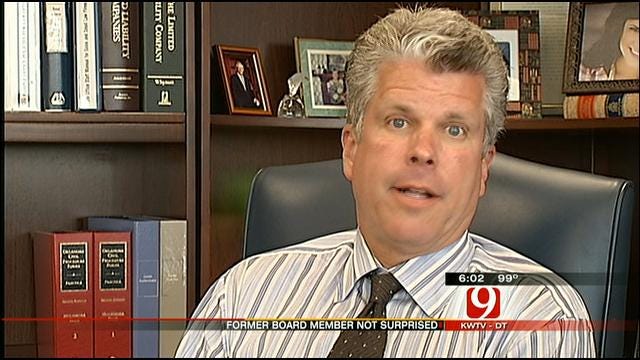
As Oklahoma County District Attorney David Prater released allegations against the pardon and parole board, News 9 began digging deeper into the inner workings of the board and its director.
It's rare, for an accused entity to allow the media to look into their practices following such allegations. In fact, the Oklahoma Pardon and Parole issued a response to News 9's inquiries nearly 8 hours after our request.
The board offered only a brief statement, but News 9 found out the accusations come as no surprise to someone who worked closely with the board.
"If the facts are correct, as outlined in David Prater's letter, I find that extraordinarily alarming and not necessarily that surprising," said Robert Rainey, who served 12 years on the Board of the Department of Corrections, a state agency working in collaboration with the Oklahoma Pardon and Parole board.
"I became concerned early on," said Rainey.
Rainey says he and other DOC board members were tasked with making organizational changes and improvements to the parole board in an effort to make the system more transparent.
Rainey says he and others worked several years to make a system that everyone could trust, rely on and everyone could understand.
"To learn of a possible secret docket or pre-docket in which one or more board members may be able to vote in the absence of the open public is quite alarming, if true," Rainey said.
Rainey explained that during his time working closely with the parole board he did not have any knowledge of a secret docket and only became aware of the issue after reading Prater's letter. But he says problems with oversight surfaced years ago.
"There was no process in place or any means for methodology to hold the parole board's executive director accountable," said Rainey.
Rainey says it also appears that some of the board members also lack accountability. In a section of the letter, Prater outlines a conversation with board member Richard Dugger who says "The board has the power to consider anyone they want."
The letter goes onto explain board member Dugger admittedly considered early parole for inmate, Maelene Chambers, when asked by a friend.
3/12/2009 Related Story: Drunk Driver Wants Sentencing Rule Changed
"Who is a friend of who is absolutely and inappropriately wrong, if true," said Rainey.
Rainey represents the victims of Maelene Chambers' crime. Chambers is convicted of manslaughter for driving drunk and crashing her car into Joseph and Betty Sharp. Joseph Sharp died from injuries from the crash. Prater says Chambers is four years too early to be placed on a parole docket.
Rainey says, for the Sharp family and all Oklahomans, Chambers should serve the time she was sentenced to.
"We have to be able to rely on our criminal justice system and I absolutely whole heartedly support David Prater's letter," said Rainey.
News 9 asked to specifically talk with board member Dugger and Executive Director Terry Jenks who are named in the letter. So far our request has been denied.
Read David Prater's entire letter to the parole board.
Communications Director Alex Weintz with the Office of Governor Mary Fallin released the following statement regarding a letter sent Wednesday morning from District Attorney David Prater objecting to several of the practices of the Oklahoma Pardon and Parole Board:
"The Pardon and Parole Board is an independent, constitutional, five-member body. Members of the Board are appointed, three by the Governor, one by the Chief Justice of the State Supreme Court, and one by the presiding Judge of the Court Criminal Appeals. The Board is charged with making clemency recommendations to the governor concerning convicted adult felons.
"When reviewing these recommendations, Governor Fallin scrutinizes each case carefully and individually. The governor's priority is to ensure justice is served, everyone is treated equally and fairly, and those who are a danger to our communities stay behind bars. As of now, the governor has approved clemency for only 51% of the inmates who have been recommended for parole by the Board.
"Governor Fallin believes that openness and transparency are essential when dealing with the Pardon and Parole Board and the clemency process. This morning, the governor's office received a letter from District Attorney David Prater listing a number of complaints against the Pardon and Parole Board, including possible violations of the Open Meetings Act. The governor takes Mr. Prater's complaints seriously; she is carefully reviewing his letter and consulting with her legal staff as well as Pardon and Parole Board members. She believes it is important for the Board to be open and transparent on all accounts. Where the potential release of inmates is concerned, transparency is especially important for both public safety reasons and to ensure the victims of crimes and their families are afforded input and fair treatment. To ensure the Board is meeting a high standard of transparency and openness, the governor has asked the Board to review its practice of posting meeting notifications and to increase the level of information it makes available to the public prior to those meetings.
"In addition to the issue of openness and transparency, Mr. Prater has made a number of other complaints regarding the operations of the Pardon and Parole Board. One of these complaints deals with the Board's practice of considering early commutation of offenders before 85% of their prison sentence has been served. The governor is reviewing Mr. Prater's arguments thoroughly and working to ensure the Board is following both the letter and the spirit of the law. Out of an abundance of caution, however, the governor has asked and the Board has agreed to place a moratorium on the practice of considering docket modifications during meetings. Furthermore, the governor has asked and the Board has agreed to request an attorney general's opinion regarding the 85% rule and the Board's ability to recommend early release.
"The governor applauds Mr. Prater for his commitment to transparency and to law and order. She will continue to investigate his allegations and ensure the law is obeyed and justice is properly served." – Alex Weintz, Communications Director, Office of Governor Mary Fallin.
Read House Speaker Kris Steele's entire statement.
The State of Oklahoma Pardon and Parole Board released the following statement in response to Prater's letter:
"The Oklahoma Pardon and Parole Board has received Mr. Prater's letter outlining his concerns with regards to the Open Meetings Act. The Board is reviewing Mr. Prater's concerns carefully. The Board believes that transparency and openness are essential when dealing with the clemency process to ensure every interested party is dealt with fairly. The Board carefully reviews and considers each offender on an individual basis.
"All Board meetings are conducted according to the Oklahoma Open Meeting Act in an open, public forum and the required notice(s) are posted with the Oklahoma Secretary of State.
"While the Board believes it has both statutory and Constitutional authority to bring offenders up for early consideration, to ensure the Board process remains open and transparent, the Chairperson will place a moratorium on the early consideration process. In addition, the Agency will request an Attorney General's Opinion regarding the 85% law and the authority to place offenders on a docket for early consideration."
Attorney General Scott Pruitt has also issued a statment regarding Prater's accusations:
"Our office has been made aware of the allegations brought forward by Oklahoma County District Attorney David Prater. Indeed, these allegations are of great concern because 85 percent crimes are some of the most heinous crimes committed against Oklahomans. The Legislature established a clear requirement so that victims and their families can be assured that an offender will serve no less than 85 percent of their sentence.
"Any practice, policy or action taken by any board or commission to mitigate or change the time served is wrong—and inconsistent with statute.
"I will do everything in my power as Attorney General to ensure that victims have confidence in our legal system and that justice is carried out to the fullest extent."

Get The Daily Update!
Be among the first to get breaking news, weather, and general news updates from News 9 delivered right to your inbox!
More Like This

August 8th, 2012

March 22nd, 2024
March 14th, 2024

February 9th, 2024
Top Headlines
April 18th, 2024


April 18th, 2024

April 18th, 2024